
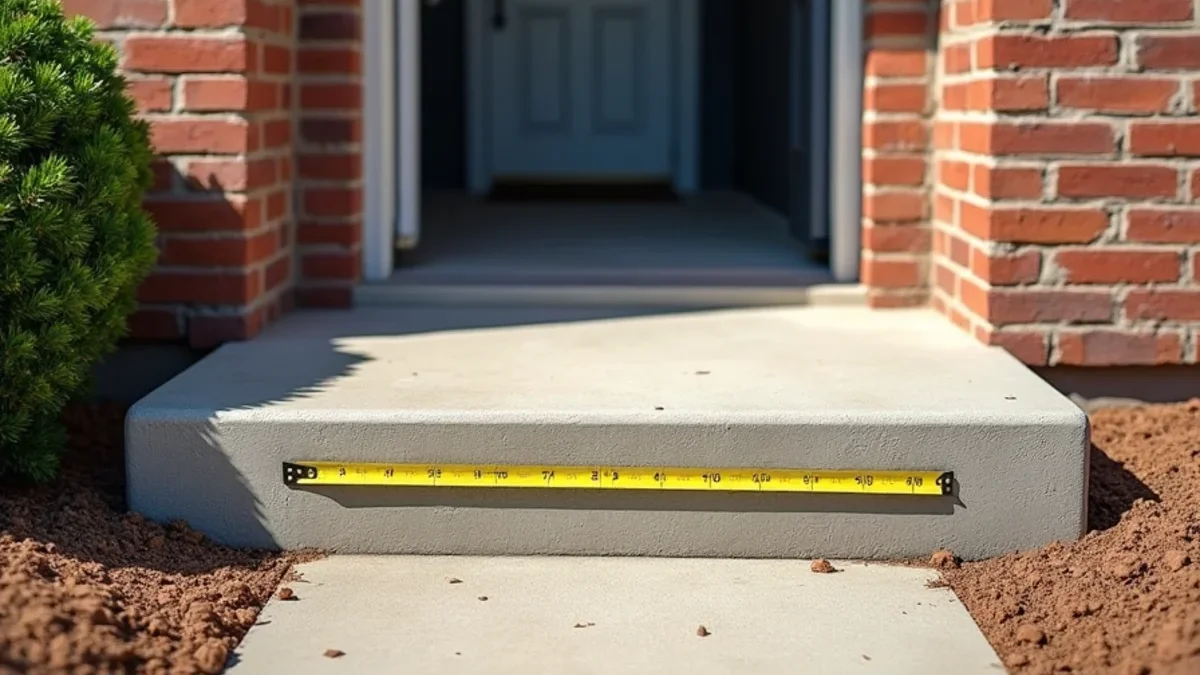
Sunken concrete steps create severe liability risks and indicate subgrade settlement or water washout beneath your porch landing. Small offsets under 1/2 inch can be diamond-shaved; sinking slabs with stable subbases can be polyurethane foam leveled; severely detached or fractured steps require full demolition, subgrade stone compaction, and an engineered monolithic repour.
Immediate Safety Assessment and Trip Hazard Thresholds
Sunken concrete steps and uneven entryway landings represent one of the single greatest premises liability hazards for South Carolina property owners. Under the Americans with Disabilities Act (ADA Section 303) and standard municipal building codes, any vertical surface displacement greater than 1/4 inch constitutes an actionable trip hazard. When front porch steps settle 1 to 3 inches downward, they create irregular riser heights that catch toes, cause ankle roll-overs, and expose homeowners to substantial liability.
If you notice your steps pulling away from your brick foundation or tilting sideways toward the yard, evaluate the following immediate concerns:
- Measure Vertical Separation: Check the gap between the top step tread and the porch threshold. If the gap exceeds 3/8 inch, rainwater is entering the void behind the brick veneer, rotting wooden sill plates and framing.
- Inspect Structural Support Posts: On covered porches, determine whether porch columns rest directly on the sinking concrete landing. If the landing settles, the column loses structural bearing, causing porch roof sagging and ceiling drywall cracks.
- Temporary Hazard Mitigation: Place high-visibility warning cones or non-slip ramps across severely settled thresholds while scheduling an on-site structural assessment with our team.
Investing in permanent concrete solutions—including professional Sidewalk Trip Hazard & ADA Repair and precision Sunken Concrete Leveling—protects your family, guests, and delivery drivers from serious injuries.
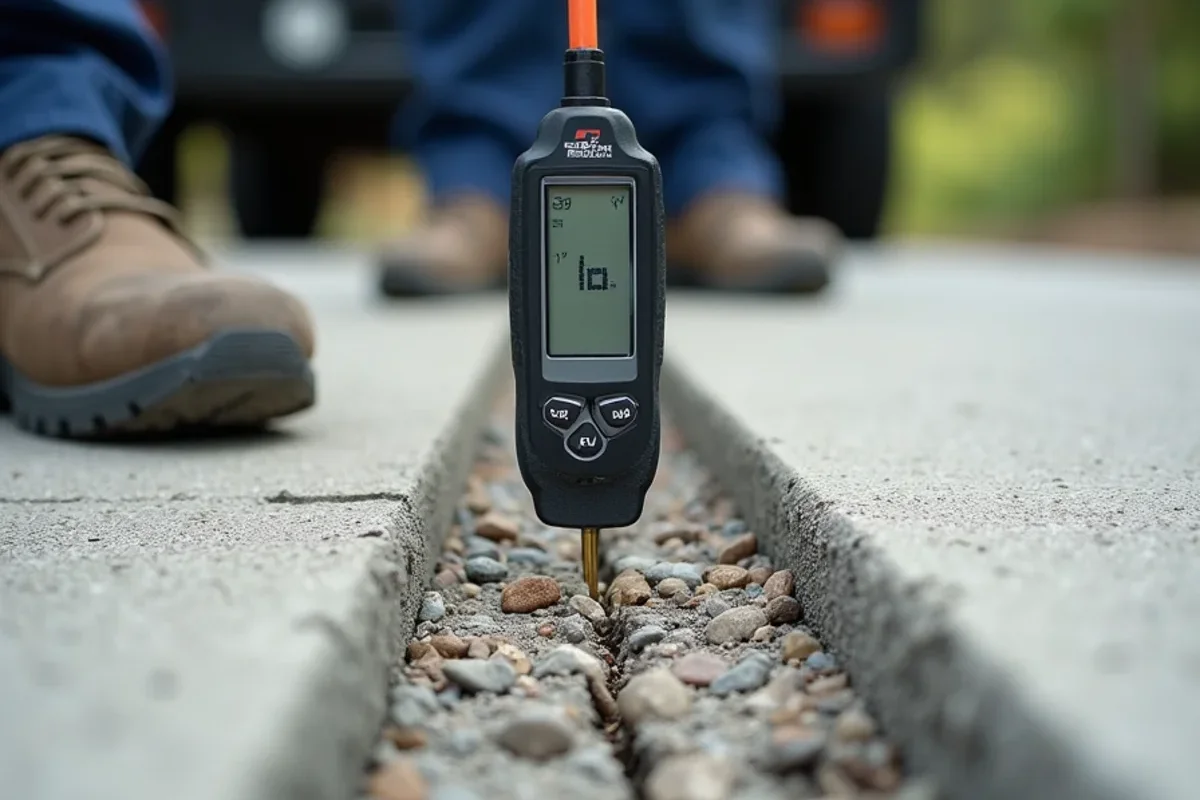
Root Causes: Soil Consolidation, Downspouts & Kaolin Washouts
Why do concrete entrance steps sink while the main home foundation remains stationary? Across Aiken County and the Central Savannah River Area, three geotechnical mechanisms drive stair settlement:
Backfill Consolidation in the Foundation Overdig Zone When a South Carolina home is constructed, the basement or crawlspace foundation requires an excavation trench 2 to 3 feet wider than the foundation wall (the overdig zone). After the foundation is laid, this perimeter trench is loosely backfilled with uncompacted soil. When heavy concrete steps weighing 2,000 to 4,000 pounds are subsequently cast over this loose backfill, gravity slowly consolidates the soil over 5 to 15 years, causing the steps to sink and pivot backward toward the house.
Concentrated Downspout Runoff Scouring Gutters that discharge rainwater within 3 feet of porch steps saturate the porous Sandhills sand or soft kaolin clay pockets beneath the landing. As turbulent storm runoff scours fine sand grains away, hollow air voids form under the concrete footing. Once the void reaches critical mass, the unsupported step structure suddenly shears downward.
Seasonal Red Clay Shrink-Swell Cycling In Piedmont transition communities such as Edgefield and Johnston, high-plasticity red clay expands aggressively when saturated and shrinks dramatically during prolonged summer droughts. This volumetric movement breaks step adhesion to the foundation wall, allowing stairs to list forward.
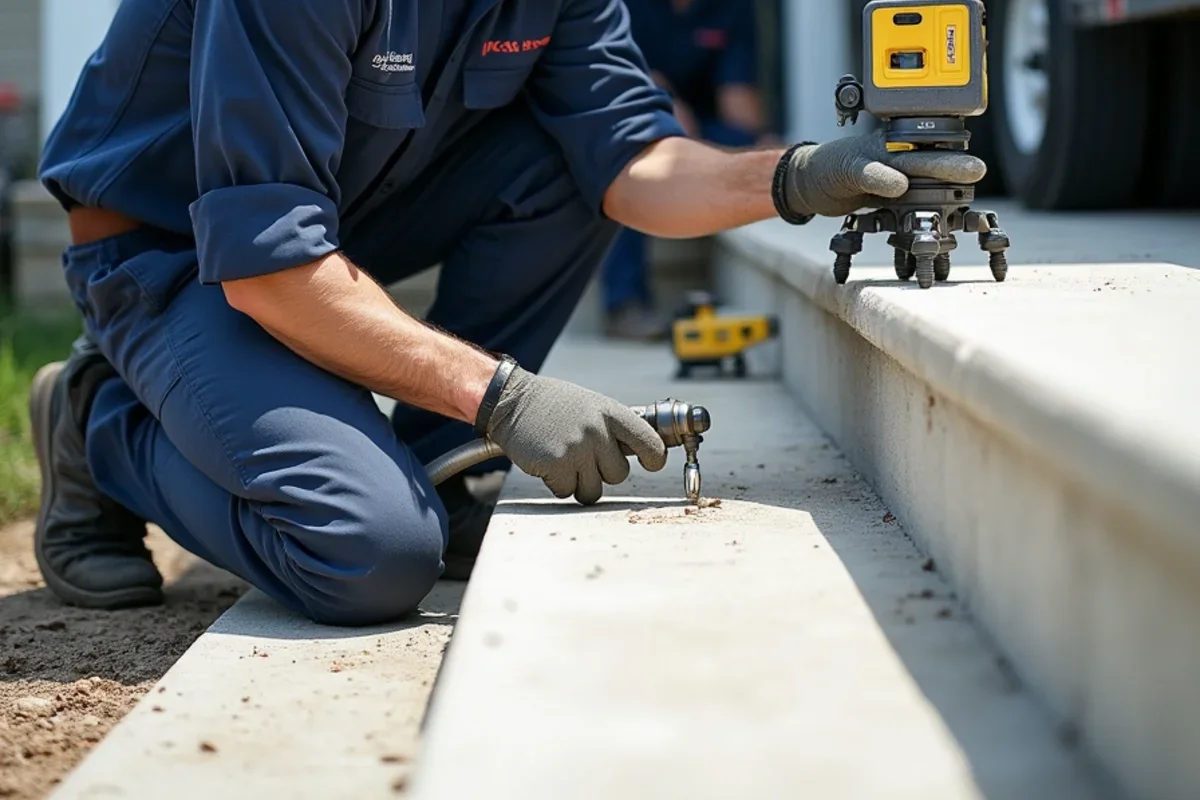
Comparison: Shaving vs Mudjacking vs Poly Foam vs Repouring
Choosing the right remedial technique depends entirely on whether the concrete is structurally intact and whether the subgrade has reached natural equilibrium:
| Repair Method | Best Application | Expected Durability | Average Cost Profile | Limitations in SC Geology |
|---|---|---|---|---|
| Dustless Diamond Shaving | Minor joint offsets 1/4" to 1/2" | 10+ years | Low ($150–$400) | Only flattens lip; cannot lift sunken steps or fill underground voids |
| Traditional Mudjacking | Slabs on firm subsoil | 2–5 years | Moderate ($500–$1,200) | Heavy cement-soil slurry adds 100 lbs/cu.ft, often causing re-settlement |
| High-Density Poly Foam | Intact hollow landings | 5–10 years | Moderate ($800–$1,800) | Lightweight; ineffective if soil is actively washing out or steps are shattered |
| Engineered Demo & Repour | Fractured, detached, or multi-inch drops | 25+ years (Lifetime) | Comprehensive ($1,800–$3,500) | Requires full removal, compacted aggregate base, and rebar-tied monolithic footing |

Foundation Uncoupling: Protecting Brick Veneer and Porch Posts
A critical mistake made by inexperienced handymen is attempting to anchor sinking concrete steps back to the house using masonry wedge anchors. A multi-ton concrete staircase settling on loose soil will exert tremendous downward shear force. If bolted directly to brick veneer, the settling stairs will rip the brick veneer entirely away from the home's timber framing, causing thousands of dollars in catastrophic structural wall damage.
Steps must be engineered to move independently of the house foundation or supported by an independent, frost-depth footing. At FPC Construction, we install closed-cell expansion joint material between new stair pours and the exterior foundation wall. This flexible barrier prevents thermal stress transfer while sealing out moisture and insects.
The Engineered Demolition and Rebuilding Standard
When concrete steps have fractured or settled beyond the safe limits of polyurethane lifting, FPC Construction executes a comprehensive reconstruction:
- Step 1: Controlled Demolition: We utilize compact mini-excavators equipped with hydraulic breakers to segment and extract the heavy concrete without damaging adjacent brick veneer or foundation landscaping.
- Step 2: Subgrade Excavation to Solid Earth: We excavate through the loose overdig zone down to unyielding, virgin native soil.
- Step 3: Thickened Monolithic Spread Footing: We form an engineered monolithic concrete footing with a minimum 8-inch thickness, reinforced with a continuous #4 rebar cage.
- Step 4: Compaction of Stone Leveling Bed: Under all flat landing surfaces, we compact South Carolina CR-14 crushed granite stone to 95% Standard Proctor density.
- Step 5: Monolithic Pour with Precision Formwork: We pour the entire flight of steps and the landing as a single monolithic unit using 4,000+ PSI ready-mix concrete, ensuring zero cold joints between steps.
- Step 6: Uniform Broom Texturing: We hand-finish every tread with a non-slip broom texture and tool smooth 1/2-inch radius safety edges.
South Carolina Residential Code: Riser Height and Tread Uniformity
The South Carolina Residential Building Code (IRC Section R311.7) mandates strict dimensional tolerances for all exterior residential staircases:
- Maximum Riser Height: 7 3/4 inches (196 mm).
- Minimum Tread Depth: 10 inches (254 mm).
- Riser Uniformity Tolerance: The greatest riser height within any flight of stairs cannot exceed the smallest by more than 3/8 inch (9.5 mm).
When steps sink unevenly, the bottom riser often shrinks to 4 inches while the top riser stretches to 10 inches, creating an illegal, code-violating staircase that home inspectors immediately flag during property sales. Our rebuilds guarantee 100% compliance with South Carolina residential codes.
Next Steps: Eliminate Your Entryway Trip Hazard Today
Do not wait for a family member or delivery carrier to stumble on sunken entryway steps. Contact FPC Construction at (833) 334-0468 for a free on-site engineering assessment and detailed written quote within 24 hours.
Speak Directly with a South Carolina Concrete Specialist
Guaranteed 1-hour callback · On-site evaluation in 48 hours · Free written estimate
Article Frequently Asked Questions
Key takeaways and common homeowner inquiries answered by our concrete team.